
Remember your middle school science class? You probably learned a an absolute, unbreakable rule of physics: metals carry electricity and plastics stop it. That is why the cable for your phone has copper wire inside and a plastic cover outside. Plastic is the ultimate insulator.
But what if science broke its own rule?
In the year 2000, three scientists were awarded the Nobel Prize in Chemistry for a discovery that sounded like pure science fiction: they found a way to make plastic conduct electricity.
Welcome to the world of the Conductive Polymer. This special material. Feels like regular plastic but it can carry an electrical charge like metal. Far from a laboratory experiment, it is the invisible force actively rewiring everything from electric vehicles (EVs) to the foldable smartphone in your pocket.
Here is why “electric plastics” are changing the face of modern manufacturing, and how cutting-edge nanotechnology makes them possible.
The Magic Behind the Material: How Does It Work?
In a piece of plastic electrons stay tightly attached to their atoms. Since they don’t move freely electricity can’t pass through.
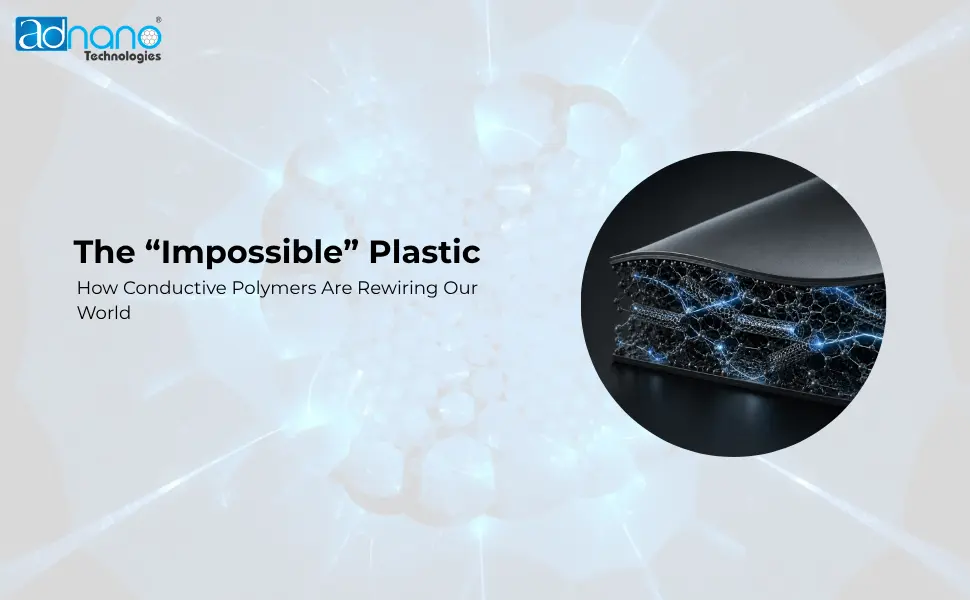
Then with smart chemical engineering and nanotechnology scientists can mix the plastic with tiny super-conductive materials things like graphene or carbon nanotubes also known as CNTs.
It’s like adding a network inside the plastic almost like a nervous system for the material. When these tiny conductive bits are spread out evenly through the plastic they form a web of electrical paths. The end result? A kind of hybrid material that keeps all the good qualities of plastic lightweight, flexible and resistant to rust but now it can carry electricity just like metal. It’s plastic, with superpowers.
Why the World is Going Crazy for Conductive Polymers
Plastics are already electric. Copper, steel and aluminum are traditional materials used in huge industries worldwide. They are now being replaced by an increasingly demanded conductive polymer for several revolutionary reasons.
- Lighter, Faster Electric Vehicles (EVs): In the EV and aerospace industries, weight is the enemy. Heavy metals drain batteries and burn more fuel. By replacing bulky metal housings and battery components with conductive plastics, manufacturers can shed massive amounts of weight while maintaining crucial electrical conductivity and electromagnetic shielding.
- The Future of Flexible Tech & Wearables: Ever wonder how foldable smartphone screens bend without snapping in half, or how smart clothing can track your heart rate? Rigid metal wires break when bent repeatedly. Flexible conductive polymers allow circuits to stretch and bend seamlessly.
- Stopping Invisible Explosions (ESD Protection): Have you ever shocked yourself touching a doorknob? That same tiny static spark can instantly destroy a multi-million-dollar microchip. Conductive polymers safely bleed away static electricity (Electrostatic Discharge), providing an invisible shield for sensitive technology during manufacturing and shipping.
Of course, creating these space-age plastics isn’t as simple as dumping carbon into melted plastic. Add too much, and the plastic becomes brittle and shatters. Add too little, and it won’t conduct a charge at all. Achieving the perfect “Goldilocks” zone requires absolute nanoscale precision.
That is where true industry pioneers step in, taking this incredible science and turning it into scalable, real-world manufacturing solutions.
Innovation Spotlight: Conductive Polymer Solutions by Adnano Technologies
As a pioneer in advanced nanomaterials, Adnano Technologies specializes in manufacturing high-performance conductive masterbatches. By integrating cutting-edge conductive carbon, graphene, and carbon nanotubes into custom polymer carriers, Adnano enables manufacturers to achieve precise electrical conductivity levels while maintaining optimal mechanical strength and processing ease.
At Adnano Technologies, we manufacture advanced Carbon Nanotube (CNT)-based Conductive Masterbatches engineered for specific polymer systems. Each formulation is optimized to deliver excellent electrical conductivity, uniform nanotube dispersion, and superior mechanical properties while maintaining compatibility with the intended polymer matrix.
Conductive PA6 Masterbatch Our Carbon Nanotube-PA6 Conductive Masterbatch is specially designed for engineering plastics that demand both high electrical conductivity and outstanding mechanical performance. The optimized CNT dispersion ensures reliable conductivity while preserving the strength and durability of polyamide components.
- Key Applications: Automotive components, Electronic housings, Industrial machinery parts, Engineering plastic products.
Conductive PP Masterbatch The Carbon Nanotube-PP Conductive Masterbatch is developed specifically for polypropylene-based applications requiring effective electrostatic discharge (ESD) protection and controlled electrical conductivity. It offers excellent processability while maintaining the lightweight and versatile characteristics of polypropylene.
- Key Applications: Automotive interior components, Conductive packaging trays, Industrial containers, Consumer electronics components.
Conductive LLDPE Masterbatch Our Carbon Nanotube-LLDPE Conductive Masterbatch is formulated for extrusion, flexible packaging, and film applications where lightweight conductivity and static dissipation are essential. The masterbatch provides uniform nanotube distribution, enabling consistent electrical performance throughout the finished product.
- Key Applications: Antistatic films, Conductive packaging solutions, Industrial liners, Flexible conductive products.
The Future is Flexible, Lightweight, and Conductive
We are stepping out of the rigid, heavy machinery of the past and into an era of flexible, smart, and ultra-lightweight technology. The conductive polymer proves that we no longer have to choose between the electrical conductivity of metal and the versatile durability of plastic. Today, we can finally have the best of both worlds.
The next time you unfold a sleek smart device, marvel at the range of a new electric vehicle, or unbox a sensitive computer component, take a closer look. You might just be witnessing the invisible magic of electric plastics at work.