
Electrically Conductive Carbon Nanotubes LLDPE/HDPE Masterbatch
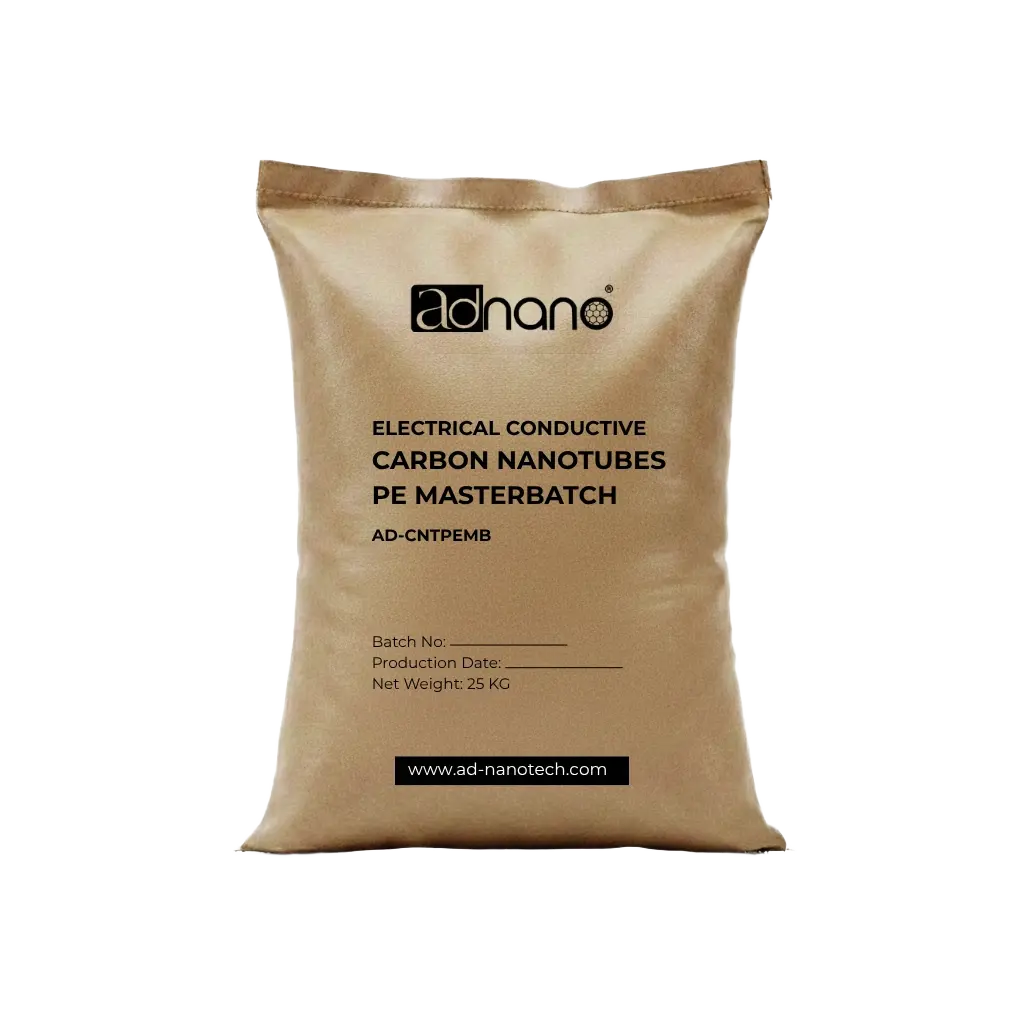
ADCNT-LLDPE MB is an advanced Electrically Conductive Carbon Nanotubes Linear low‑density polyethylene (LLDPE) and High-density polyethylene (HDPE) Masterbatch. Engineered with 20% ± 1 wt% customized carbon nanotubes in a PE matrix for ESD and electrical conductivity.
Electrical Performance
ADCNT-PE MB achieves percolation at exceptionally low loading levels, preserving the mechanical properties of the base polymer while delivering permanent conductivity.
Masterbatch Properties
When diluted into neat LLDPE/HDPE, the masterbatch forms a conductive CNT network that dramatically reduces electrical resistivity.
| Product Name | ADCNT-PE MB |
|---|---|
| Polymer Matrix | Polyethylene (PE) |
| Conductive Additive | Customized Carbon Nanotubes |
| CNT Loading | 20% ± 1 wt% |
| Physical Form |
Black Pellets |
| MFI (230°C / 2.16 kg) | Not Measurable (Very low flow) |
| Real Density | 588 g/L |
Appearance & Flow
| Target Surface Resistivity band | Target CNT in PE(wt%) | Required CNT‑PE MB (wt%) loading in PE |
| ~10⁷ Ω/sq (ESD) | 3% | ~ 15% of MB |
| ~10⁴ Ω/sq (conductive) | 5% | ~ 25% of MB |
| ~10³ Ω/sq (conductive / EMI‑assist) | 7% | ~ 35% of MB |
| <10³ Ω/sq (Highly conductive) | ~10% | ~50 % of MB |
Application Matrix
Shear & Mixing: Process using standard PE screws with moderate screw speed to avoid excessive shear that may damage CNT structure and reduce conductivity. Ensure proper premixing (tumbler or gravimetric feeder) for uniform dispersion and consistent ESD performance.

Processing Guidelines
Proper handling and processing are critical to achieving optimal dispersion and electrical performance. The CNT network must be established uniformly throughout the polymer matrix.
Storage & Handling
- Store in cool, dry conditions away from direct sunlight and heat.
- Keep packaging sealed when not in use.
- If exposed to moisture, redry material before processing.
Drying Requiremnts
Drying is generally not required for PE. If moisture exposure occurs, dry pellets at 50–70°C before processing.
Processing Temperature
Typical melt temperature: 180–230°C depending on the base LLDPE grade.